The headlines are everywhere. "AI is coming for creative jobs." "Will artists be replaced by algorithms?" In a world where artificial intelligence can write a poem, design a logo, or compose a piece of music, it’s natural to feel a sense of unease. There’s a widespread fear that the spark of human creativity is about to be extinguished by the cold logic of a machine.
Some people worry that AI will replace human creativity. We see it differently.
At Great Matter, we believe this fear comes from a fundamental misunderstanding of what AI is and what creativity requires. We don’t see AI as a competitor; we see it as a powerful creative assistant. It’s not the artist, but the artist’s most capable apprentice. This post explains how our creative experts use AI not to replace their ingenuity, but to amplify it—helping us brainstorm bigger ideas and deliver even more amazing results for our clients.
The Real Role of AI: Assistant, Not Artist
The misconception lies in viewing AI as the final creator. While impressive, AI lacks the essential ingredients of true creativity: intent, empathy, lived experience, and strategic insight. An AI can generate an image, but it doesn’t understand the cultural nuance that will make it resonate with a specific audience. It can write copy, but it doesn't feel the emotional pull of a story that will build a lasting brand connection.
That’s why our approach is simple: we let AI do what machines do best, so our humans can do what they do best. We use AI to handle the heavy lifting, the data processing, and the repetitive tasks, freeing up our creative experts to focus on the high-level thinking, strategy, and emotional intelligence that no algorithm can replicate.
How We Use AI to Brainstorm Bigger, Bolder Ideas
The blank page can be daunting for any creative. AI is our secret weapon for turning that blank page into a universe of possibilities.
- As a Brainstorming Catalyst: When we're developing a new campaign, we can use AI to generate hundreds of initial concepts, headline variations, or visual styles in minutes. This isn't the final product; it's the raw material. It allows our team to explore unexpected avenues and push past the first, most obvious ideas to find true innovation.
- As a Creative Sparring Partner: Stuck on a concept? Our copywriters and designers use AI as a sounding board. They can feed it a core idea and ask it to provide alternative angles, metaphors, or perspectives. This process often breaks creative blocks and helps refine a good idea into a great one.
- As an Audience Simulator: We can prompt AI to brainstorm from the viewpoint of a specific customer persona. By asking, "Generate campaign ideas for a 35-year-old busy working mom who values sustainability," we get starting points that are already steeped in empathy, ensuring our creative work is audience-centric from the very beginning.
How We Use AI to Deliver More Amazing Results
A great idea is only as good as its execution. AI helps us refine our creative output and optimize its performance with incredible speed and precision.
- For Content & Copy Refinement: Our writers use AI to polish first drafts, check for tone consistency across different channels, and generate multiple versions of ad copy for large-scale A/B testing. The core message and story are always human-led; the AI is the tireless editor that helps us perfect its delivery.
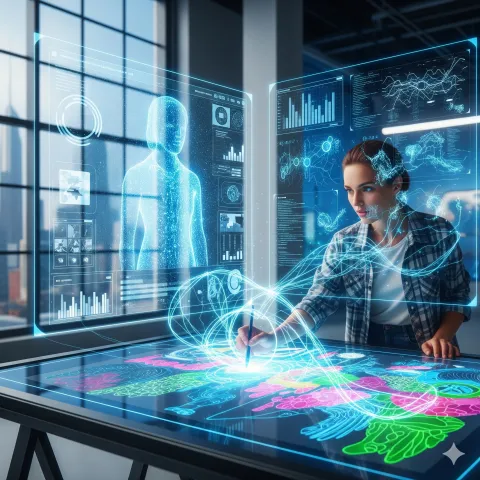
- For Rapid Visual Prototyping: Instead of spending days on a single visual mockup, our art directors can use AI to generate a dozen different conceptual images in under an hour. This allows us to present clients with a range of visual directions early in the process, speeding up feedback and ensuring the final result is perfectly aligned with their vision.
- For Data-Informed Creativity: We use AI to analyze performance data and identify which creative elements—colors, keywords, image styles—are resonating most with an audience. This feedback loop doesn't dictate our creative, but it informs it, allowing our team to make smarter, data-backed decisions.
The Future is Human-Led and AI-Powered
Ultimately, AI is a tool—the most powerful creative tool ever invented, but a tool nonetheless. It lacks the strategic mind to build a brand, the empathy to connect with a customer, and the taste to know when an idea just feels right.
At Great Matter, we’re not afraid of AI because we are confident in the irreplaceable value of human ingenuity. We’re embracing it to eliminate tedious work, unlock new possibilities, and supercharge our ability to deliver the strategic, emotionally resonant creative that builds brands. The future of marketing isn’t human vs. machine; it’s human creativity, amplified by machines. And we’re already building it.