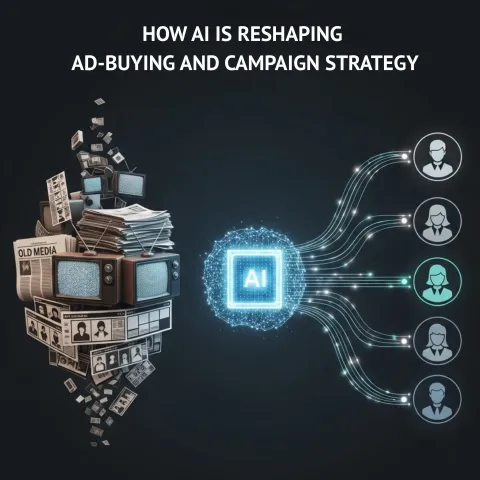
Digital advertising is undergoing a quiet but profound evolution, driven by the steady rise of Artificial Intelligence. Rather than a disruptive force, AI is becoming a thoughtful partner, subtly reshaping how we reach audiences, create content, and define success. It’s not a revolution overnight, but a daily shift in how the work gets done.
It’s a move away from the familiar cycle of manual adjustments and toward a more collaborative partnership between human strategy and machine intelligence. Let's explore what this new landscape looks like and how we, as marketers, can gracefully navigate it while remaining firmly in control.
For years, effective ad-buying meant meticulously setting every parameter by hand that’s the budgets, bids, audiences, and placements. Today, platforms like Google Performance Max and Meta Advantage+ offer a new approach. They use AI to automate these complex decisions, testing countless possibilities(through AB Testing) in the background to find the most efficient path to our goals.
This doesn’t make us less important. If anything, it makes us more essential. . We shift from being operators to being strategists. The opportunity now lies in providing the system with the best possible inputs: clearly defined objectives, high-quality creative assets, and strong, unambiguous signals about what a successful conversion looks like for our business.
One of the most remarkable capabilities of generative AI is its ability to produce countless variations of headlines, copy, and visuals. This opens the door to personalization at a scale we've never seen before. Right?
However, this is precisely where our human insight is most valuable. An algorithm, for all its power, doesn't understand the nuance, history, and soul of your brand. Without thoughtful guidance, automated messaging can feel inconsistent or miss the mark. The goal is to use AI as an amplifier for our creative vision—a tool to execute our brand story more efficiently, not to write it for us.
Perhaps the most significant change is the shift from a reactive to a predictive model. Instead of just analyzing past results, AI can now forecast which combinations of ads and audiences are most likely to succeed. By identifying patterns in user behavior and market trends, it offers a glimpse into future performance.
This predictive insight allows for smarter allocation of resources and helps us pivot more quickly when a strategy isn't resonating. To harness this power, our focus turns to nurturing the system—feeding it with clean, quality data and refining our success metrics so its predictions become ever more accurate.
A common concern is that automation might make the marketer's role less important. We believe the opposite is true: AI handles the tactical heavy lifting, which frees us to concentrate on what truly matters.
Our focus is elevated from the minutiae of campaign launches to the bigger picture of our brand's journey. We are the architects of the overarching strategy, the guardians of brand consistency, and the thoughtful analysts who interpret performance through a human lens. Our role is to use these powerful tools with intention and wisdom, not to follow them blindly.
A Final Thought: Evolving with Purpose
The integration of AI into advertising isn’t about “automate and forget.” It’s an invitation to evolve. The brands that will thrive in this new era are the ones that know how to blend smart automation with sharp human strategy.
As we plan our next campaign, the question isn’t whether to use AI—it’s how. How do we partner with this technology in a way that keeps our message clear, authentic, and unmistakably human?